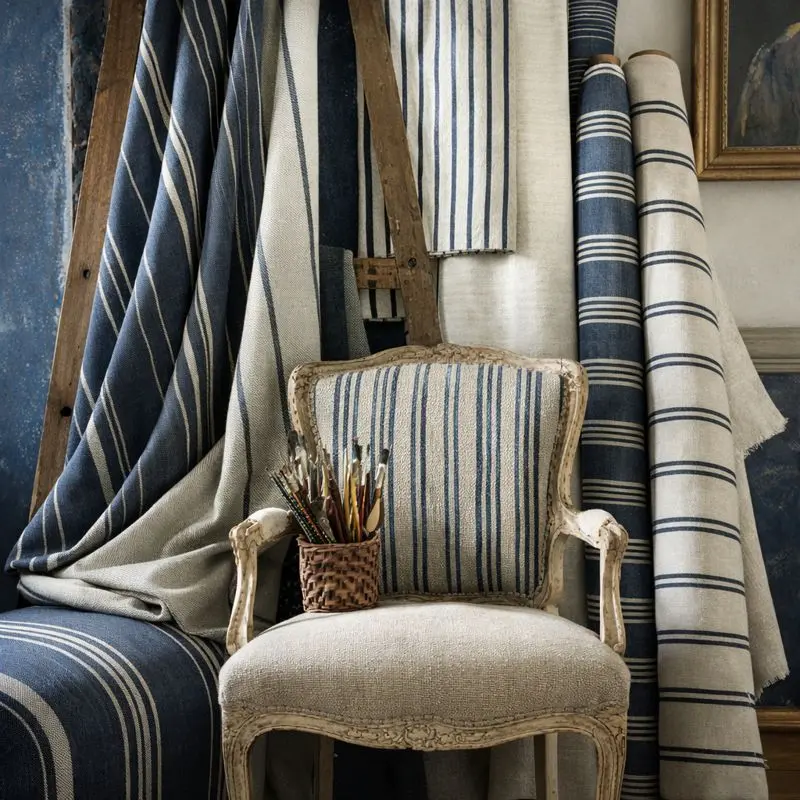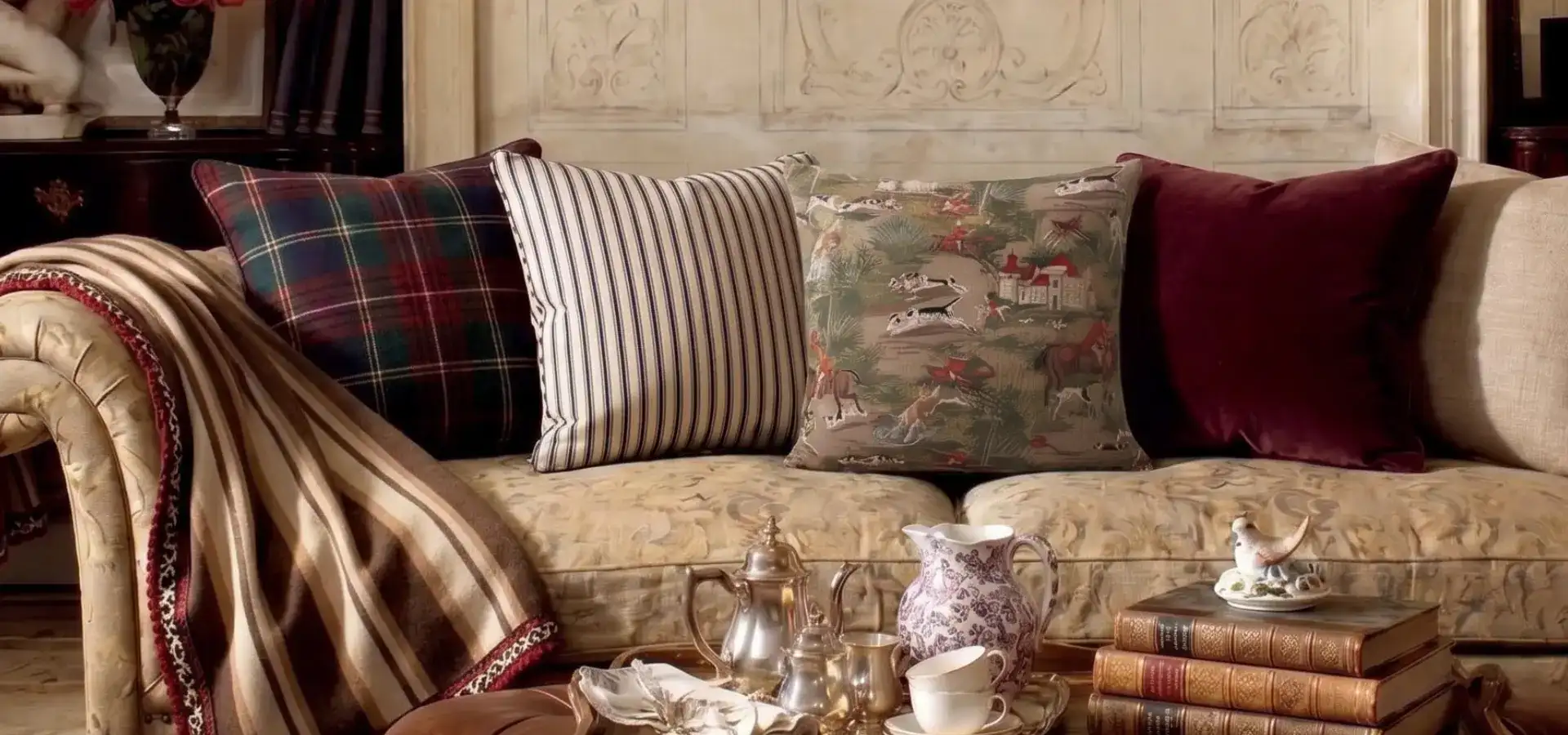
Some rooms feel finished the moment you walk in. Not because it shouts — but because everything within it has been placed with intention. The sofa is often the first thing you notice, and more often than not, it is the pillows that tell you whether someone truly understands a room or has merely furnished one.
- — Use 22–24" pillows as anchors at the outer corners
- — Layer 18–20" pillows in front of the anchors
- — Add one lumbar pillow centrally at the front
- —Mix textures before colours — linen against velvet, wool against tapestry
- —Odd numbers feel more natural than even — 3 or 5, rarely 4 or 6
- — If the arrangement feels busy, edit down — don't add
Before a single pillow is placed, study the sofa itself. Its scale, its depth, and the height of its back will determine everything — how many pillows it can hold, what sizes make sense, and whether the arrangement should be formal or relaxed.
A deep, low-slung sofa calls for larger pillows — 22 or 24 inches — that can be propped against the back without disappearing into the seat. A tighter, more architectural frame reads better with a restrained grouping: perhaps two pillows and a lumbar, nothing more. A generous Chesterfield or rolled-arm settee can carry a layered arrangement of four to six without looking busy, provided the materials are disciplined.
The sofa sets the terms. The pillows answer.
The Rule of Proportion for Sofa Pillows
Proportion is the single most important principle in pillow arrangement — and the most frequently ignored. The instinct to fill a sofa with matching pairs of identical pillows produces something that looks assembled rather than composed. Instead, think in three layers.
The Anchor
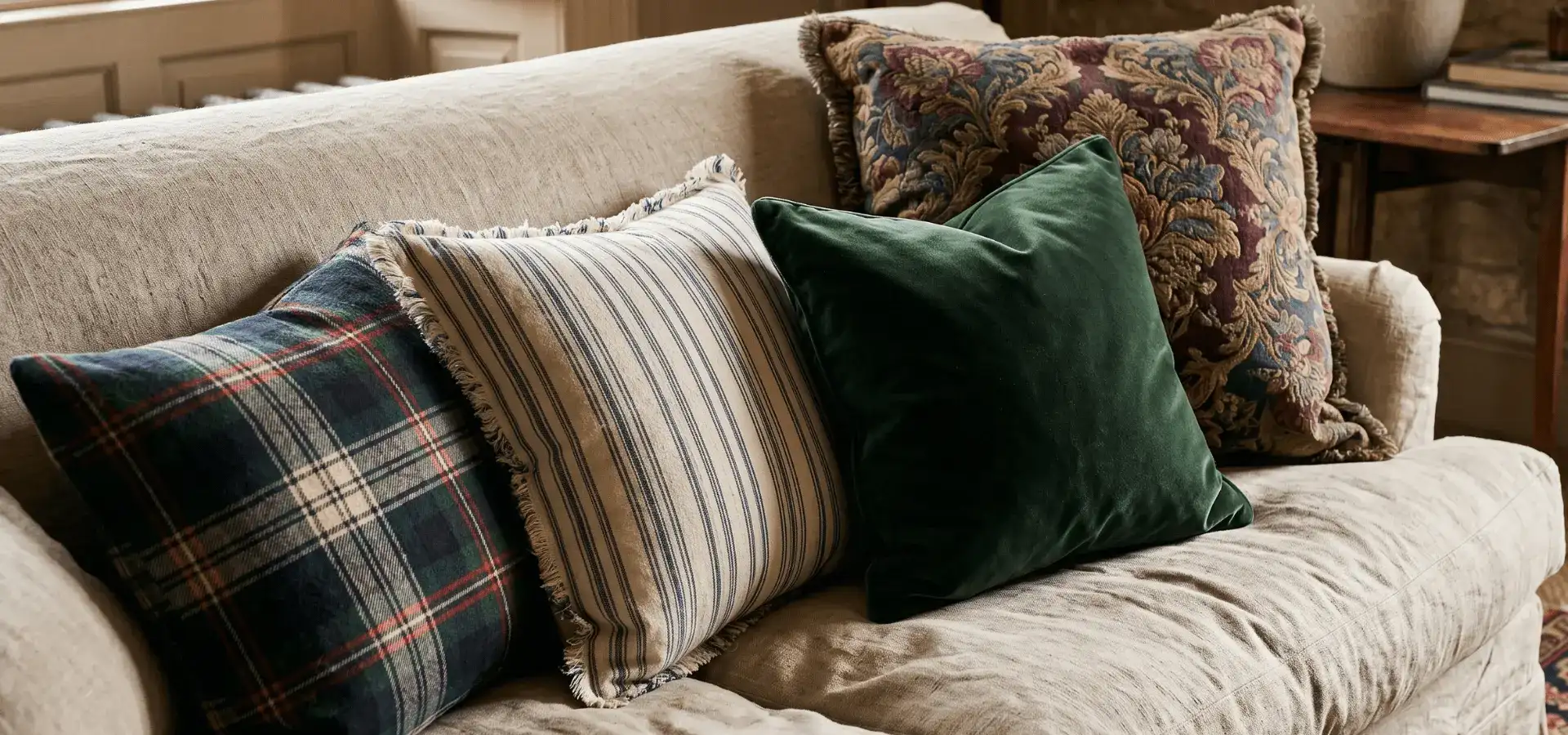
Your largest pillow — 22 to 24 inches square — placed at the outside corners. This is the structural foundation of the arrangement. Choose a textile with presence: a wool plaid, a tapestry weave, a substantial linen. The Ashbourne Plaid Wool & Velvet Throw Pillow works beautifully here — its weight and checked pattern give a sofa immediate character without demanding attention.
The Layer
A slightly smaller pillow — 18 to 20 inches — placed in front of or beside the anchor. This is where texture enters: velvet against wool, embroidery against plain linen, tapestry against stripe. The contrast should be subtle — a shift in surface rather than a clash of pattern. The Almond Blossom Velvet Throw Pillow placed against a wool anchor introduces softness and light reflection without disruption.
The Lumbar
Placed centrally, along the sofa's front. The lumbar is the finishing note — it establishes the horizontal line, draws the eye inward, and gives the arrangement its resolution. It should be quieter than the pillows behind it. A stripe, a plain linen, or a tailored canvas all perform this role with the appropriate restraint.
What this looks like in practice
On Symmetry in Decorative Pillow Arrangement
Perfect symmetry is orderly, but rarely memorable. Most rooms benefit from a little variation. Asymmetry, handled with confidence, is far more interesting — and more honest to the way rooms are actually lived in.
A useful approach: mirror the sizes, vary the textiles. Two 22-inch anchors at either end, each in a different fabric — a tapestry on one side, a plaid on the other. Alternatively, work in odd numbers. Three pillows on a two-seat sofa — one large, one medium, one lumbar — produces an arrangement that feels natural rather than composed. The eye reads it as lived-in, which is precisely what a sofa should be.
The Textile Hierarchy
"The single most common mistake is using too many pillows, not too few."
After styling hundreds of sofas, the pattern is consistent: homeowners almost always use too many pillows, never too few. Removing a single pillow improves more rooms than adding one. The arrangement should feel settled — as though it has always been there. The moment it feels assembled, something needs to come out. Start with three. Add only if the sofa genuinely needs it. — Reeva Sethi
| Sofa Size | Recommended Pillows | Suggested Arrangement |
|---|---|---|
| Loveseat (2-seat) | 2–3 pillows | 2 anchors + 1 lumbar |
| Standard Sofa (3-seat) | 4–5 pillows | 2 anchors + 2 layers + 1 lumbar |
| Large Sofa / Chesterfield | 5–7 pillows | 2 anchors + 2–3 layers + 1–2 lumbars |
| Sectional | 6–9 pillows | Treat each section as its own sofa |
| Settee / Loveseat | 2 pillows | 1 anchor each end, no lumbar needed |
Not all fabrics belong together. The art of the well-arranged sofa lies in understanding which textiles complement and which compete.
How each textile performs in an arrangement
Colour: Less Than You Think
The instinct to match decorative pillows to the room's existing palette is understandable but limiting. A more considered approach is to identify the room's dominant tones — the rug, the sofa fabric, the walls — and introduce couch pillows that sit within that family while offering one considered departure.
A room built on warm neutrals — sand, oatmeal, aged linen — is deepened rather than disrupted by a single pillow in a deeper tone such as burgundy, olive, or navy. The Ashbourne Plaid, with its layered tones of navy and green over a neutral ground, performs this function well — it belongs to the neutral world but extends it.
Avoid the trap of the monochromatic arrangement. Five pillows in variations of the same colour produce something that reads as a showroom rather than a home. Introduce contrast — even a small amount — and the arrangement immediately acquires life.
The Lumbar: An Underused Instrument
The lumbar pillow is one of the most useful elements in a sofa arrangement. Placed at the front, it gives the arrangement a final point of focus and helps unify the pillows behind it. It should be placed in front of the layered arrangement, centred, and it should be quieter than what sits behind it.
A plain linen lumbar is always correct. A simple stripe, a subtle texture, a canvas with minimal detail — these all perform the role without competing. The Reade Oatmeal Leather & Canvas Cushion, with its woven leather front and tailored rectangular form, is an unusually refined lumbar option — it brings material interest without pattern, which is precisely what the position requires.
How Interior Designers Style Sofa Pillows
There is a difference between how most people arrange living room pillows and how designers do it. Most people start with what they have. Designers start with the sofa — its scale, its fabric, its position in the room — and work outward from there.
The designer's workflow is not complicated, but it is deliberate. It begins before any pillow is touched.
Assess the room's colour temperature first
Before choosing a single pillow, identify the room's dominant tones — the rug, the wall colour, the sofa fabric. Every pillow chosen should belong to that temperature or offer one considered departure from it. Designers never choose pillows in isolation from the room.
Establish the anchor first, not the accent
Most homeowners choose the prettiest pillow first and build around it. Designers do the opposite — they choose the anchor (the largest, most substantial pillow) first, because everything else responds to it. The anchor sets the weight and scale of the arrangement.
Build the textile story in three materials maximum
Professional designers rarely use more than three distinct textile families in a single arrangement — typically a weave (tapestry or jacquard), a plain or near-plain (linen or canvas), and one surface-interest fabric (velvet or embroidery). More than three and the arrangement begins to feel assembled rather than composed.
Place, then edit — always remove before adding
Designers place all candidate pillows on the sofa, then remove — they never start with too few and add. The editing process is where the arrangement is actually made. The final version is almost always simpler than the first attempt.
Use feather inserts, always oversized
Every designer uses feather and down inserts, sized one to two inches larger than the cover. A 22" cover gets a 24" insert. This produces the full, slightly overstuffed appearance that photographs well and holds its form over time. Synthetic inserts flatten immediately and undermine even the most considered arrangement.
What to Avoid
What undermines a pillow arrangement
- Over-stuffed inserts — A pillow that slumps immediately undermines the arrangement. The insert should be at least as large as the cover. Feather and down hold their form better than synthetic fill.
- Too many patterns at the same scale — A large tapestry, a large plaid, and a bold stripe together produce noise rather than richness. Vary the scale of patterns within a single arrangement.
- Novelty — A pillow with a slogan, a seasonal motif, or an ironic graphic has no place in a considered interior. Choose textiles that will read as correctly in five years as they do today.
- Perfect symmetry — Identical pillows on both ends produce a waiting room. Mirror the size, vary the textile. The arrangement should feel settled, not installed.
- Filling for the sake of filling — When the arrangement feels busy, the answer is almost always to remove a pillow, not add one.
Throw pillows from $105. Ships nationwide.
Linen, velvet, wool, tapestry and jacquard weave — curated for rooms that endure. Ships nationwide to California, New York, Texas and all 50 states. Free shipping on orders over $200. Visit our Saratoga showroom serving San Jose, Los Gatos, Los Altos, Palo Alto and the Bay Area.
Reeva Sethi Home is located at 20430 Saratoga–Los Gatos Road, Saratoga, California — serving clients near San Jose, Los Gatos, Los Altos, Palo Alto, Monte Sereno and the greater Bay Area. Looking for luxury throw pillows near you? All pillows ship nationwide in 3–5 business days.
Saratoga, CA 95070
3–5 business days
Free returns
The considered arrangement in six principles
- Start with the sofa — its scale and depth determine everything else
- Layer by size: anchor (22–24"), layer (18–20"), lumbar (centre, front)
- Mirror sizes, vary textiles — symmetry of scale, variation of material
- One velvet, one tapestry, one stripe or plaid is usually enough
- The lumbar should be quieter than everything behind it
- Edit before you add — the final arrangement is almost always simpler than the first
How many throw pillows should be on a sofa?
A two-seat sofa typically holds 3 to 4 pillows. A three-seat sofa can carry 4 to 6. The number matters less than the proportion — each pillow should relate to the ones around it in size, texture, or material. When in doubt, remove one rather than add another.
What size throw pillows should I use?
Start with 22 to 24 inch square pillows as anchors at the outer corners. Layer a slightly smaller 18 to 20 inch pillow in front. Finish with a lumbar pillow in the centre. Varying the sizes creates the layered, considered look that a single uniform size cannot achieve.
Should throw pillows match the sofa?
No. Pillows that match the sofa exactly produce a showroom rather than a home. Choose pillows that belong to the same colour family as the room while introducing one considered departure. A neutral room benefits from one pillow in a deeper tone — burgundy, navy, tobacco, or olive.
How do you mix throw pillow patterns?
Mix patterns by varying scale rather than colour. A large tapestry with a fine stripe and a plain velvet reads as layered and intentional. A large tapestry with another large pattern reads as confusion. One patterned textile per arrangement is often enough — let the textures do the work.
How many pillows on a sectional sofa?
Treat each section of a sectional as its own sofa. A two-section L-shaped sectional typically holds 6–9 pillows total. The key is to treat the corner as a natural dividing point and create a balanced arrangement on each side rather than treating the sectional as one continuous surface.
What size lumbar pillow should I use?
The standard lumbar pillow for a sofa is 14" x 22" or 14" x 24". For a larger sofa or Chesterfield, a 16" x 26" lumbar reads better. The lumbar should be wide enough to feel intentional — not so narrow it looks lost in the centre of the sofa.
Can you mix floral and stripe pillows?
Yes — but vary the scale. A large floral tapestry with a fine stripe works because the patterns operate at different scales. A large floral with a large stripe compete for the same visual register and produce confusion rather than richness. One bold pattern per arrangement; everything else quieter.
Are odd numbers better than even for throw pillows?
Generally yes. Odd numbers — 3, 5, 7 — produce arrangements that feel natural and lived-in rather than composed. Even numbers tend toward symmetry, which reads as deliberate and formal. For most residential sofas, an odd number creates the settled quality that makes a room feel like a home rather than a showroom.
What pillow inserts do interior designers use?
Designers almost universally use feather and down inserts, sized one to two inches larger than the cover. A 22" pillow cover gets a 24" feather insert. This produces a full, slightly overstuffed form that holds its shape. Synthetic polyfill flattens quickly and cannot replicate the natural loft of down.
Where can I find luxury throw pillows near San Jose or the Bay Area?
Reeva Sethi Home in Saratoga carries a curated collection of luxury throw pillows in linen, velvet, wool, tapestry and jacquard weave from $105. The showroom is at 20430 Saratoga–Los Gatos Road — a short drive from San Jose, Los Gatos, Los Altos and Palo Alto. All pillows also ship nationwide in 3–5 business days.
What fabrics are best for throw pillows?
Linen, wool, velvet, tapestry and jacquard weave are the most considered choices. Avoid synthetic fabrics — they flatten under light and lose their form over time. The insert matters too: feather and down hold their shape better than synthetic fill.
What is a lumbar pillow and where does it go?
A lumbar pillow is a rectangular pillow placed centrally at the front of the sofa arrangement — in front of the layered square pillows. Its role is to establish a horizontal line and give the arrangement its final resolution. It should be quieter in pattern than the pillows behind it.
Where can I buy luxury throw pillows that ship nationwide?
Reeva Sethi Home in Saratoga, California carries a curated collection of luxury throw pillows in linen, velvet, wool, tapestry and jacquard weave — priced from $105. All pillows ship nationwide from our Saratoga showroom in 3–5 business days. If you're looking for luxury throw pillows near San Jose, Los Gatos, Los Altos, Palo Alto or anywhere in the Bay Area, visit us at 20430 Saratoga–Los Gatos Road, or call 408-797-5283 to arrange a visit.
REEVA SETHI writes RS Studio as a journal of proportion, material truth, and interior permanence. These guides are for homeowners who want to understand not just what a room looks like, but why certain spaces endure. Read the full RS Studio archive →