Design Essay After Enough Rooms, the Pattern Appears The rooms people remember are rarely organized around furniture. They are organized around the way life is lived inside them.
The older I get, the more convinced I become that wisdom is largely the study of patterns. Farmers notice them. Gardeners notice them. Parents notice them. After enough years, most of us do. This essay is about one pattern in particular — and what it has changed about how I work.
In almost every house I have worked in, there is a chair that has drifted from where it was placed. Pulled toward a window. Angled toward a fireplace. Moved by someone who needed it closer to the light, or to the conversation, or to the view. Life found its own order. It always does. The question is whether the room was designed to help that happen — or whether the room looked correct in a photograph and the life had to work around it.
The older I get, the more convinced I become that wisdom is largely the study of patterns. Farmers notice them in soil and seasons. Gardeners notice them in what survives and what doesn't. Investors notice them in how markets behave over decades. Parents notice them in children long before the children notice anything about themselves. After enough years, most of us do.
When I walk into a room, I find myself looking at the same things first. Not the sofa. Not the coffee table. Certainly not the decorative objects. I look to see where people have chosen to spend their time.
The worn patch on one armchair. The stack of books that migrated from the shelf to the floor beside it. The coffee cup ring on a side table that nobody bothered to move. The chair pulled slightly out of its arrangement — angled toward the window, or toward the person who usually sits across from it. These are the honest parts of a room. The parts that tell you how it is actually used, as opposed to how it was intended to look.
Life Found Its Own Order. It Always Does.
The places people settle are almost never where the furniture was placed to direct them. They are where the light is best. Where conversation happens without effort. Where you can see both the room and the garden. Where the morning comes in.
I have seen it happen in grand houses and small apartments alike. In a room of careful symmetry and considered proportion, there is always one chair that has drifted. It started somewhere logical — flanking a sofa, completing an arrangement — and over weeks or months it moved. Pulled toward a window. Angled toward a fireplace. Turned slightly so the person sitting in it could see the door.
The chair moved because the room was telling someone something the furniture plan had not accounted for. Life found its own order. The question is whether the room was designed to help that happen — or whether the room looked correct in a photograph and the life had to work around it.
This is the pattern. And once you see it, you start to see it everywhere — not just in interiors, but in the way habits reveal character, the way paths appear in a garden where no path was planned, the way a family always ends up in the kitchen no matter how beautiful the dining room is.
Human beings reveal what matters through repeated behavior. Homes do too. The worn armchair is not a decorating problem. It is evidence. The chair drifted toward the window because the window was where life wanted to be. The room simply hadn't caught up yet.
Three Rooms That Had Already Caught Up
Let me show you what it looks like when a room is built around life rather than around furniture. Not as lessons — as observations.
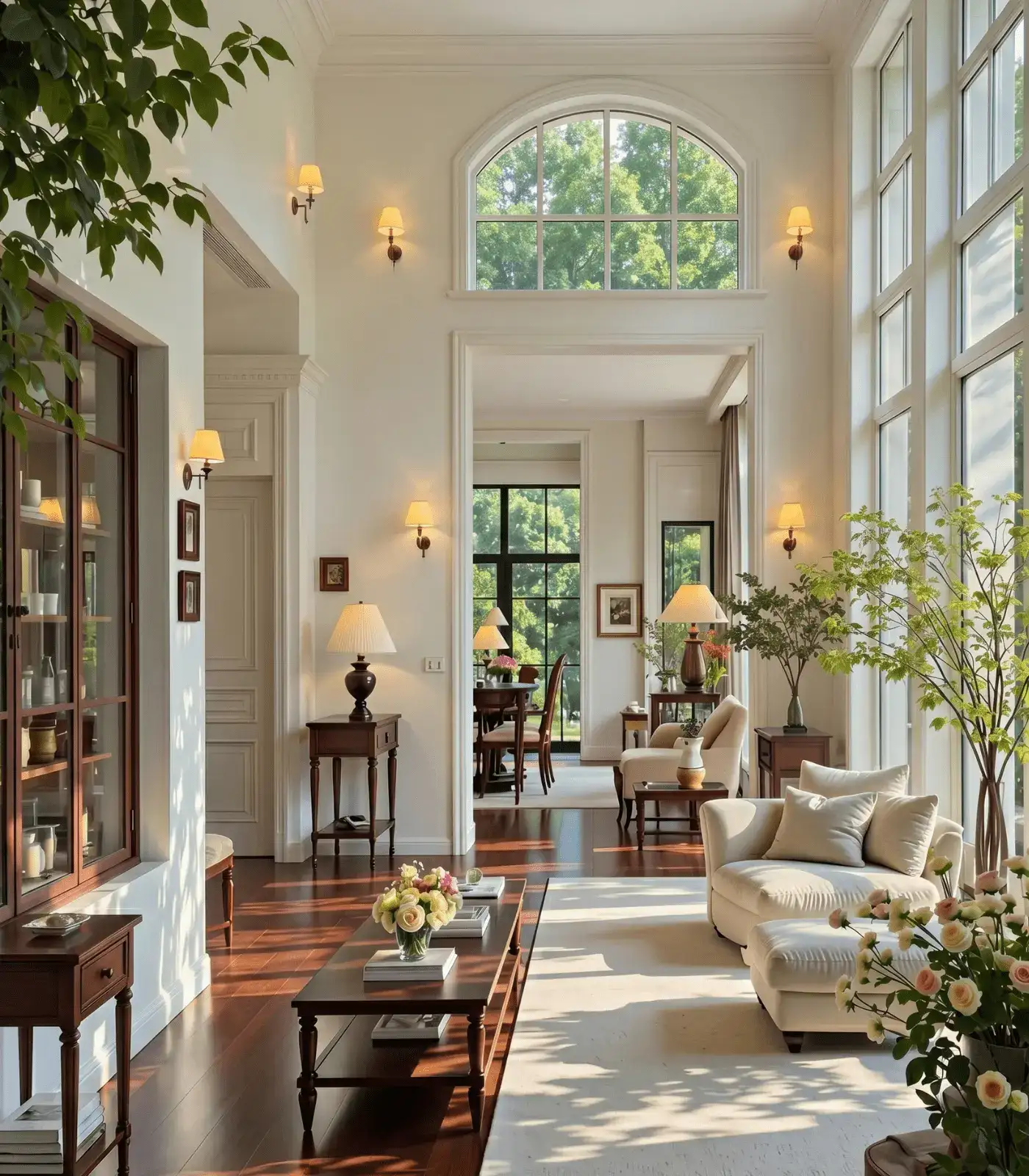
This room has almost nothing in it. One sofa. One console. A rug. A few flowers. And yet every decision was made in response to the light rather than in spite of it. The sheer curtains filter rather than block. The branching plant casts a shadow as deliberate as any piece of furniture. Nothing here was placed for the photograph. It was placed for the person who would spend an afternoon in it.
If the designer had started with the sofa, they might have put it against the wall opposite the windows. Logical. Space-efficient. Wrong. The sofa is where it is because that is where a person wants to be. The light made that obvious. The furniture simply agreed.
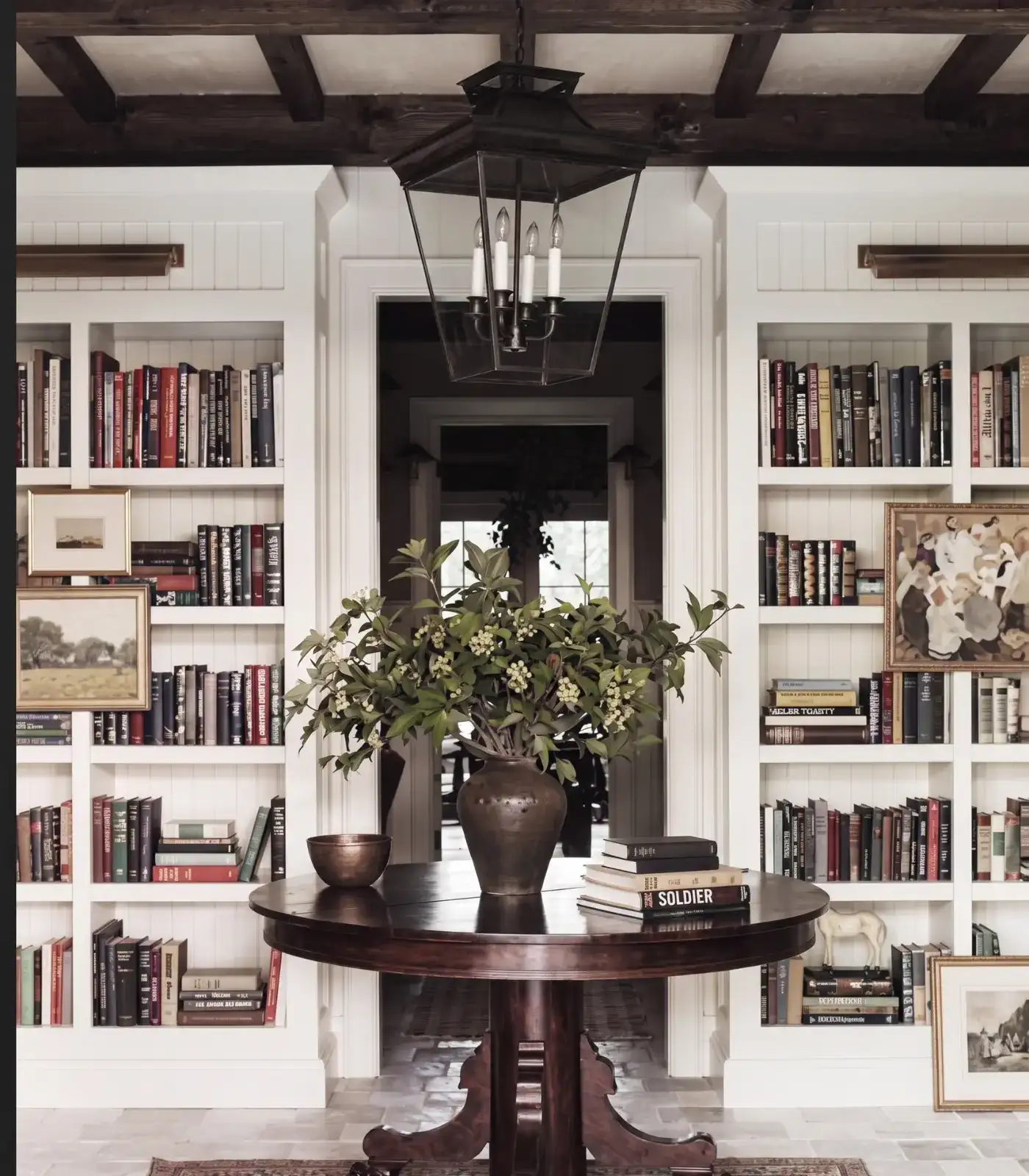
What struck me the first time I saw this room was how settled it felt. Not arranged — settled. As though the books had always been there, as though the table had found its position the way a stone finds its position in a riverbed. The bookshelves on either side of the doorway are not identical, and yet the room feels balanced — not because anyone calculated it, but because the two sides carry roughly equal weight. Balance by feel, not by rule.
Three objects on the table. A tall branch. A low bronze bowl. A horizontal stack of books. Nobody counted them. But three resolves in a way that two does not and four cannot — the same instinct that makes a three-note chord feel complete. The room's designer followed something they felt rather than something they learned. The best rooms usually do.
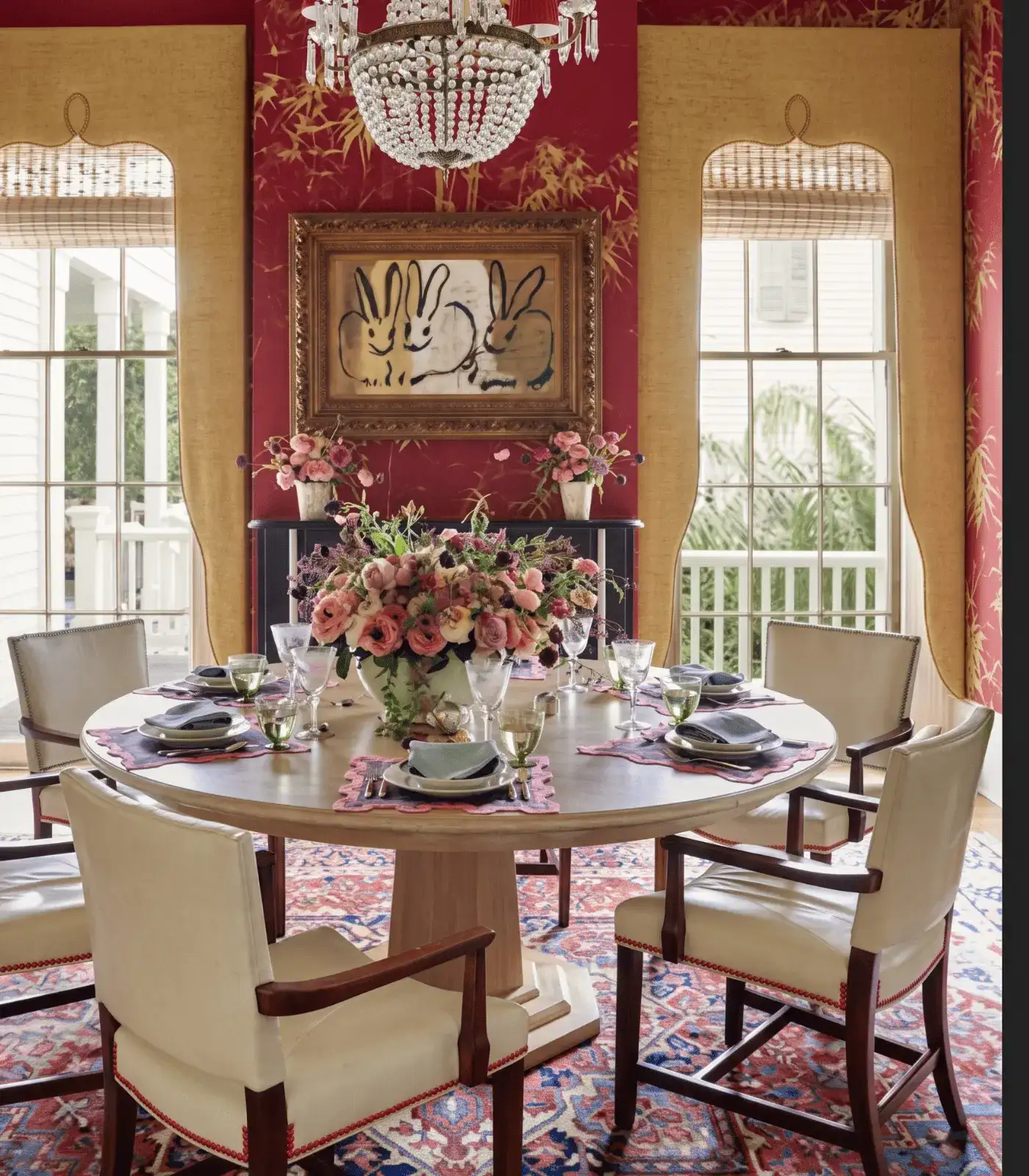
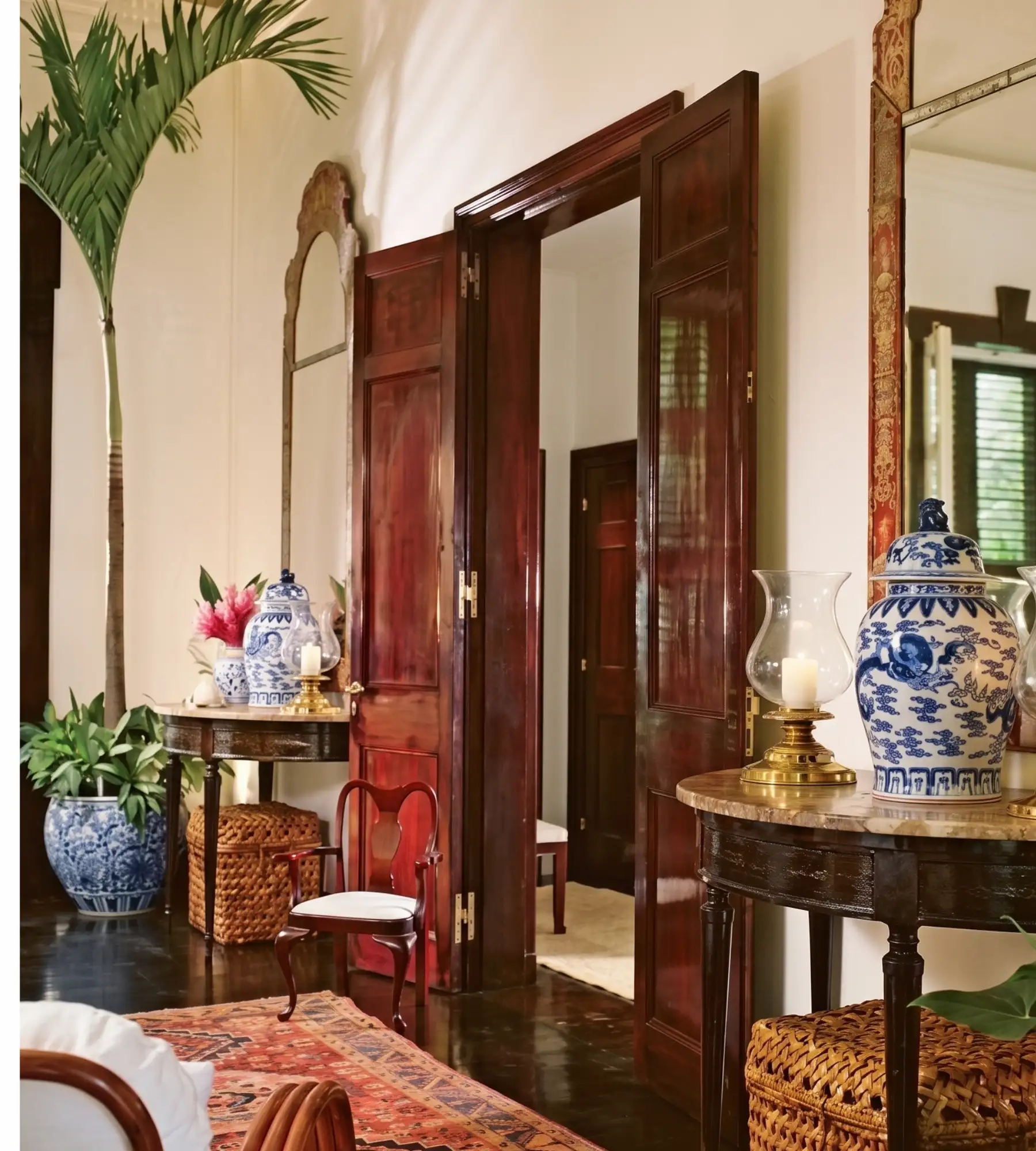
The first time I saw a room like this, I stood in the doorway for longer than was polite. It should not have worked — red walls, gold wallpaper, a chandelier with red shades, a Persian rug already busy with pattern — and yet it was completely at peace with itself. Eventually I stopped looking at individual elements and started looking at the room as a whole. And then I saw it. Red. In six places. Different reds — lacquer, woven wool, fresh petals, painted glass — but always the same temperature. Someone had thought about what kind of night this room was for. A long one. The furniture answered accordingly.
The Pattern I Keep Seeing
After enough rooms — after enough drifting chairs and worn armrests and reading corners that nobody planned — what I keep coming back to is not a sequence of decisions. It is a way of paying attention.
Find where life wants to be. In every room there is a place where the light is best, where conversation would happen without effort, where someone sitting there in the morning with a book would feel that the room had been designed for exactly this. That place exists before any furniture arrives. It is the room's natural anchor. Your job is to find it, not to invent one.
Respect the light. Not as an abstract principle — as a specific observation. Where does it fall at nine in the morning? Where does it go by four in the afternoon? A breakfast nook that catches the east light. A reading chair beside the south window. A dining table where candles at six in the evening will compete with the last of the natural light in a way that makes the room feel golden rather than dim. Light is the condition. Everything else is arranged inside it.
Arrange for conversation. Furniture pushed against walls creates a waiting room. Furniture arranged inward — even slightly, even imperfectly — creates a gathering. Every seat should face another seat. Every seat should have a surface within reach. These are not rules. They are observations about how people actually use rooms when the rooms are working correctly.
Let history accumulate. A room assembled in a single afternoon has no history. A worn footstool. A lamp repaired more than once. A piece brought home because it meant something, not because it completed a look. These arrive slowly. History is what makes a room feel inhabited rather than installed. You cannot buy it. It accumulates — the way character accumulates, the way a garden matures, the way a friendship deepens.
Buy more slowly than you think you should. The anxiety of an empty room — the pressure to fill it, finish it, make it look complete — is the single most expensive force in interior design. It drives people toward the sofa first, the matching set, the room that looks done by Saturday. Patience produces better rooms. Always. Without exception.
The Problem People Are Actually Trying to Solve
Farmers know that the field always tells the truth. Plant the wrong crop in the wrong soil, and the field will say so — not in a season, but over many seasons, through what fails to thrive. Gardeners know the same thing. The plants reveal whether the conditions are right long before any expert is consulted.
Homes do this too. The worn chair, the reading corner nobody planned, the table everyone gathers around even though it was not designated as the gathering place — these are the field telling the truth. They reveal what matters long before anyone says it aloud.
Three things to look for in any room that feels right
The reason people furnish rooms badly is not that they lack taste. It is that they are solving the wrong problem.
The emptiness is not the problem. The emptiness is the starting point — the room before any decision has been made badly.
The actual problem is this: how do you build a room that knows how to hold a life? That question produces different answers than "what should I buy?" It produces rooms where the chair has worn to the shape of the person who sits in it every morning. Where the books have spilled onto the floor because there was nowhere else to put them. Where the light comes in at four in the afternoon and hits a corner of the rug in a way that stops you every time.
The rooms people remember ten years later were built around the second brief. They are never quite finished. They are always in the middle of becoming. And that — the ongoing becoming — is exactly what makes them feel right.
Every room begins with observation.
If you would like help understanding how light, habit, and architecture can shape your home, we would be delighted to visit.
Reeva Sethi Home is located at 20430 Saratoga–Los Gatos Road, Saratoga, California. The showroom serves Saratoga, Los Gatos, Los Altos, Monte Sereno, and the greater Bay Area.
Saratoga, CA 95070
11am – 4pm
Bespoke sourcing
Key Design Principles
- Read the light before placing any object — the room already has a natural orientation
- Balance is intention toward equilibrium, not perfect mirroring
- Scale speaks to the body before aesthetics speak to the eye
- Every composition — musical, visual, spatial — requires negative space to breathe
- Repetition creates rhythm; three objects are a composition, one is just an object
- Rooms that feel inhabited were built slowly — one object, one year at a time
How do interior designers start a room?
Most experienced designers start with the light and the architecture of the room — not the furniture. They observe how natural light moves through the space at different times of day, identify where people naturally want to gather, and define the zone with a rug before a single piece of seating is placed.
What makes a room feel timeless?
Timeless rooms are built around proportion, natural materials, and objects with history. They were not assembled in a single afternoon. They contain things that have earned their place — a worn leather chair, a faded rug, a lamp that has been repaired. Nothing was chosen because it was trending. Everything was chosen because it was right.
Why do some homes feel more inviting than others?
The most inviting homes have furniture arranged for people, not for appearances. Seating faces inward, toward conversation. Lighting is at eye level, not overhead. There are surfaces within reach of every chair. The room feels like it was designed for the person who lives there — not for the person who might visit and be impressed.
What is lived-in luxury?
Lived-in luxury is not about expense. It is about rooms that feel genuinely occupied — where the quality of materials is apparent but nothing is precious or off-limits. A room with a worn leather footstool, hand-loomed textiles, and furniture built from solid hardwood reads as more luxurious than a room filled with expensive items that cannot be touched. The luxury is in the permanence, not the price.
How do you decorate without following trends?
Start by asking whether something will still feel right in ten years. Trends answer the question of what is current. Proportion, material quality, and personal meaning answer the question of what endures. Buy fewer things, choose better, and layer slowly. The rooms that age best were never designed to be of the moment.
What furniture should I buy first when decorating a room?
Start with a rug, not a sofa. The rug defines where life happens and anchors every other decision. Before that, observe the light — where it enters the room and where it falls at different times of day. That tells you where your best chair should go.
Should I start decorating with the sofa?
No. The sofa is one of the last decisions, not the first. Starting with the sofa forces every other purchase to react to it rather than to the room itself. Begin with the light, then the rug, then seating placement — the sofa follows from those decisions naturally.
Why do rooms feel assembled instead of lived in?
Rooms feel assembled when everything was purchased at once and arranged for appearance rather than use. A room with no history — no worn edges, no objects with meaning, no evidence of time — reads as a showroom rather than a home.
What is the correct order to furnish a room?
Observe the light first. Place your best chair where you naturally want to sit. Add a rug to define the zone. Arrange seating for conversation. Then choose the sofa. Layer objects with meaning slowly over time. That order produces rooms that feel right years later.
How do I make a room feel lived in?
Layer objects over time rather than all at once. A worn leather footstool, cracked book spines, a lamp that has been repaired more than once. Rooms that feel lived in were built slowly — one considered object, one memory at a time. You cannot buy that feeling in a single afternoon.
Where can I get interior design help in Saratoga or the Bay Area?
Reeva Sethi Home in Saratoga offers complimentary in-home consultations for clients in Saratoga, Los Gatos, Los Altos, Monte Sereno, and the greater Bay Area. Call 408-797-5283 or book a visit online.
REEVA SETHI writes RS Studio as a journal of proportion, material truth, and interior permanence. These essays are for homeowners and designers who want to understand not just what a room looks like, but why certain spaces endure. Read the full RS Studio archive →