The Adirondack chair is one of the most recognizable pieces of outdoor furniture in America. It is so familiar that most of us have stopped seeing it. It is on porches, around fire pits, beside pools, at wineries, summer camps, and beach houses across America. Designers specify it for coastal cottages and mountain retreats. Homeowners buy it generation after generation. Yet few people know the history of the Adirondack chair — and even its origins are surprisingly uncertain.
A Summer Cottage, a Problem, and a Family Put to Work
Around 1900, on the banks of Lake Champlain in upstate New York, a man named Thomas Lee was trying to solve a straightforward problem. He wanted comfortable outdoor seating for his summer cottage. He cut boards, nailed them together, and kept calling family members over to sit in each version and tell him when the angles felt right.
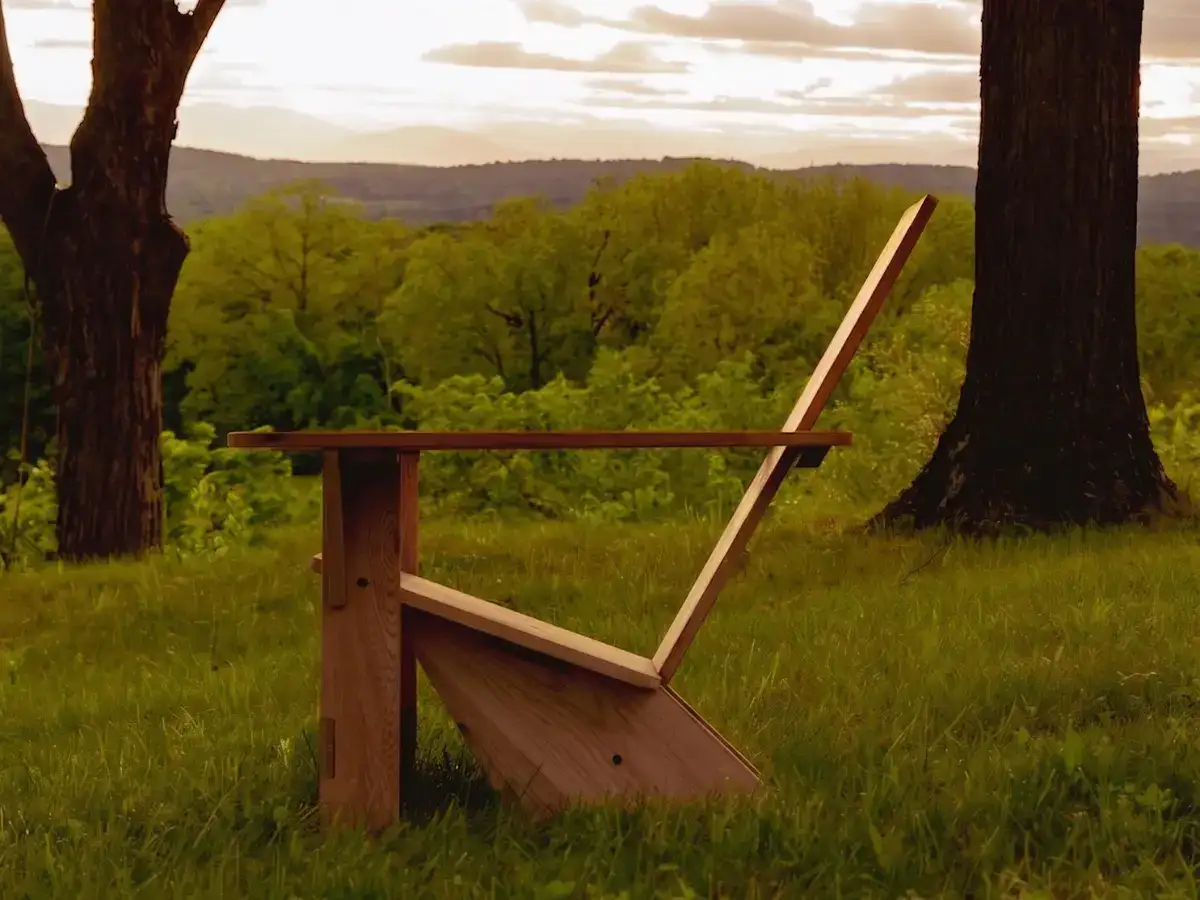
His niece recalled it decades later — Uncle Tom gathering the family to test chair after chair until the proportions felt exactly right. The result had two features that would define the design for generations: a deeply reclined seat and broad, flat armrests wide enough to hold a drink, a book, or a plate.
Those wide arms were not a stylistic decision. They were the whole point. Neither was the reclined angle. The design naturally shifts weight backward, creating a more relaxed sitting position than most upright outdoor chairs.
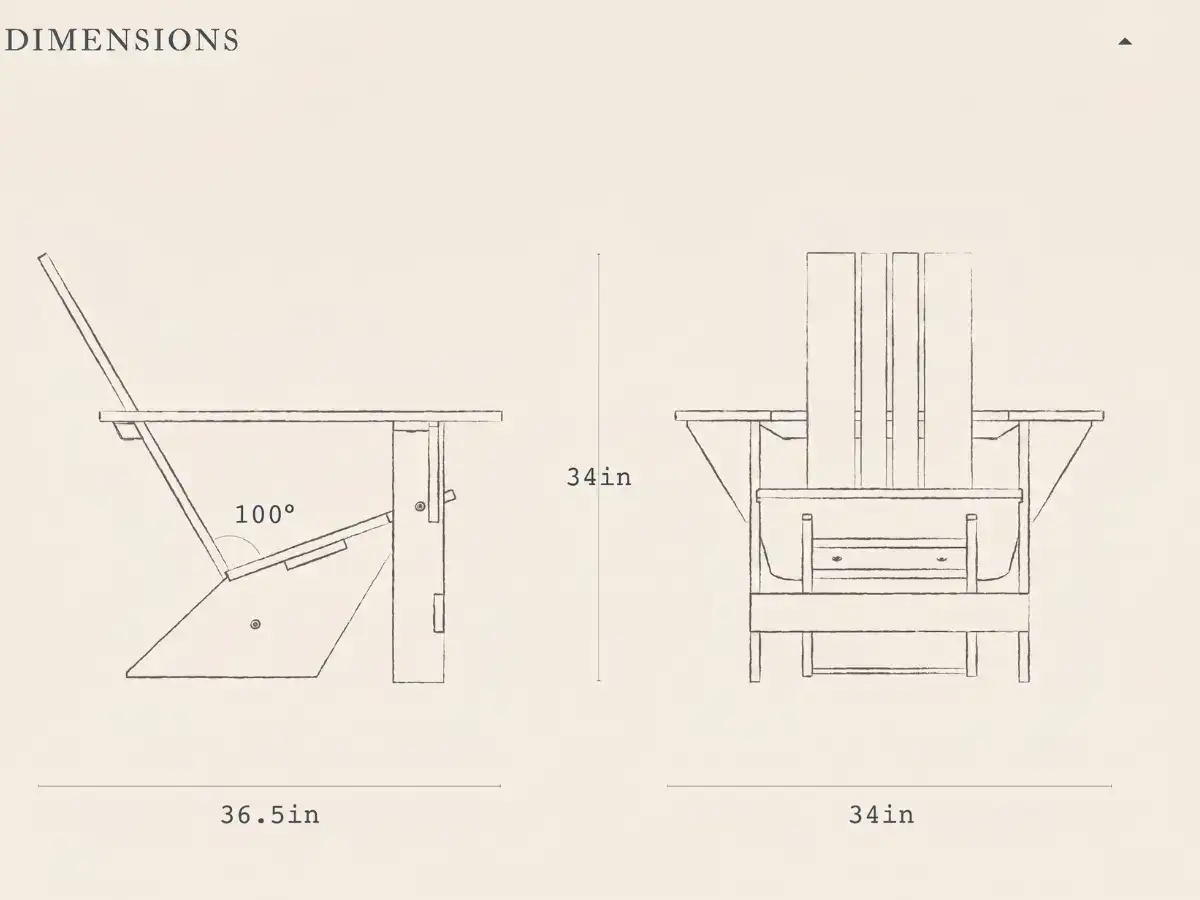
The dimensions shown above explain why the chair feels familiar even after more than a century. The reclined back, low seat height, and broad armrests are not decorative choices. They are functional decisions that have remained largely unchanged since the original Westport Chair.
Why Adirondack Chairs Are So Comfortable
The comfort of the Adirondack chair is not accidental. It is the result of several geometric decisions that Thomas Lee arrived at through trial and error — and that no subsequent designer has found reason to substantially change.
The seat is angled backward. This shifts the body's weight onto the back of the chair rather than the seat edge, reducing pressure on the backs of the legs — the primary cause of discomfort in conventional outdoor seating. The high, slanted backrest follows the natural curve of the spine rather than fighting it. And the seat height sits lower than standard chairs, which encourages a more reclined posture and distributes weight more evenly across the seat.
The wide flat arms are set at a height that requires no effort to rest your hands or wrists on them. A glass, a book, a telephone — each stays put without being held. This is not a minor convenience. It is the difference between a chair you sit in and a chair you settle into.
Together these proportions produce a chair that is genuinely difficult to leave before you are ready. That may explain why the Adirondack chair acquired its reputation for contemplation — not because people are sentimental about wooden furniture, but because the geometry makes stopping feel natural.
There is another intriguing chapter to the story. At the turn of the twentieth century, the Adirondack region became known for the "fresh air cure," attracting thousands of tuberculosis patients who spent long hours resting outdoors on porches and in reclining chairs. Some historians believe that culture of outdoor recovery helped create an appetite for comfortable outdoor seating, making the Adirondack chair arrive at exactly the right moment.
There is also a detail most people do not know. The Adirondack chair was not designed for coastal living, though that is where most of us picture it. It was designed for slope seating — for mountainside terrain, where an ordinary flat-bottomed chair would tilt and wobble. The angled legs and reclined seat were a structural solution to an uneven landscape. The fact that the chair feels equally at home on a flat porch, a beach, or a campground is not coincidence. It is the reward for solving a real problem precisely.
The Carpenter Who Saw the Potential
Lee's friend Harry Bunnell, a local carpenter, recognized something in the design. He patented a version in 1905 under the name "Westport Chair" — named not for the mountains but for the town on Lake Champlain where Lee had his cottage. For the next twenty-five years Bunnell manufactured them from local hemlock and basswood, stamping each one with his patent number.
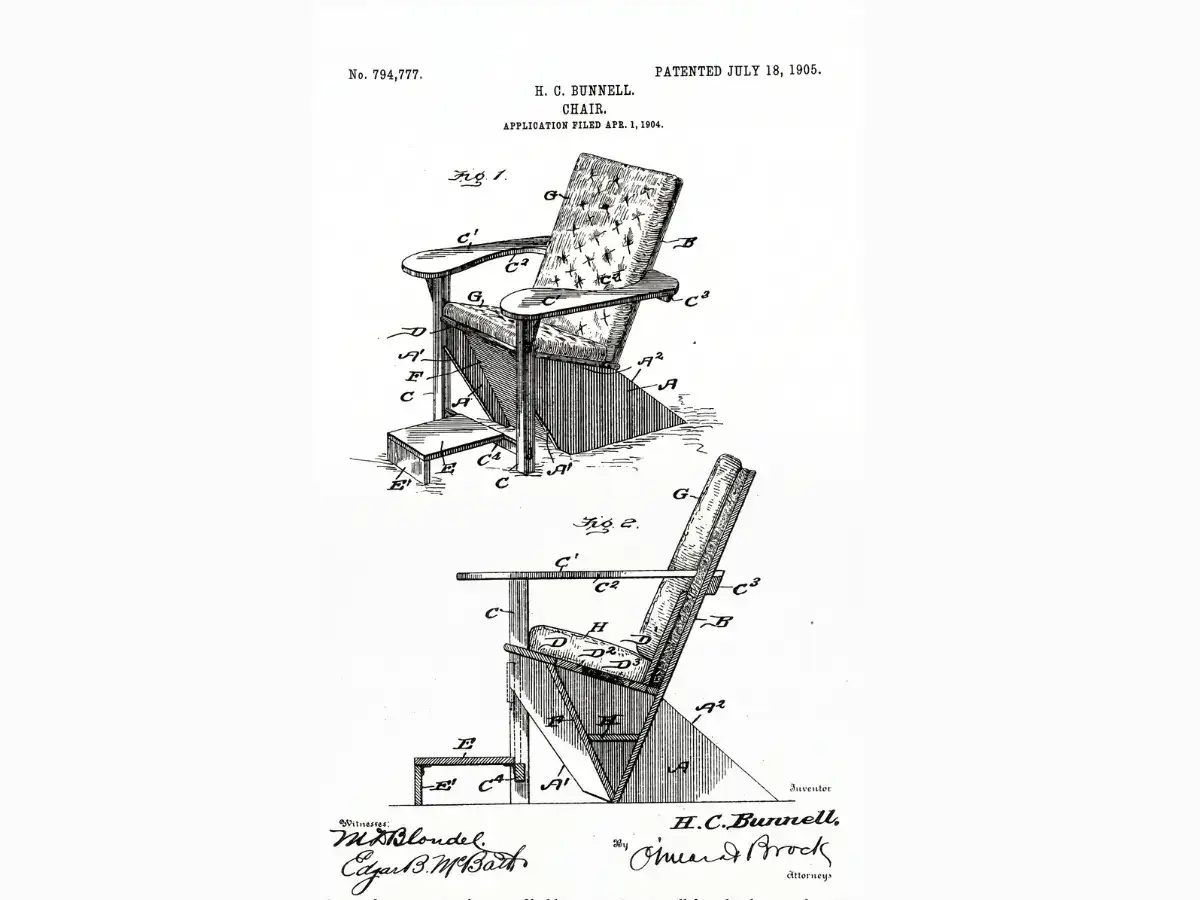
Historians still debate whether the chair actually originated in the Adirondack Mountains at all. Most point to the Westport Chair as its true predecessor. The irony is that one of America's most recognizable outdoor chairs may not have originated in the Adirondacks at all. The provenance is murky — fitting, perhaps, for a design that spread not through official channels but through the simple fact that it worked.
From Local Curiosity to National Icon: The Adirondack Chair History Timeline
A Short Chronology
- c. 1900 — Thomas Lee builds the first version for his Lake Champlain cottage, testing angles with family members until the proportions feel right
- 1905 — Carpenter Harry Bunnell patents the "Westport Chair" and begins manufacturing in hemlock and basswood
- 1904–1930 — Bunnell sells the chair; locals copy and adapt it; the design begins escaping any single ownership
- 1938 — Irving Wolpin of New Jersey patents a wider version with multiple slats and narrower arms
- Post-WWII — The adapted version becomes a national fixture; nobody owns it anymore
- Today — Available in cedar, teak, recycled composite, and everything between; the silhouette unchanged
The Design That Nobody Could Own
What happened next is what makes the story genuinely interesting. Locals saw the chair, liked it, and made their own. The slatted construction was simple enough that hobbyists working with scraps could reproduce it. It spread the way good ideas spread, not through marketing but through making sense.
By the Second World War a slightly altered version — wider seat, narrower arms, multiple slats — had become a fixture across the country. By the time Irving Wolpin patented his version in 1938, versions of the original Westport Chair design had already escaped any single claim on it. It had simply become the chair. The one on the porch.
Locals saw the chair, liked it, and made their own. It spread the way good ideas spread, not through marketing but through making sense.
The Chair That Escaped Fashion
Most outdoor furniture spends its life chasing fashion. The Adirondack chair seems never to have noticed.
The Adirondack chair simply remained.
It never became fashionable enough to become unfashionable. While other designs cycled in and out of popularity, the Adirondack simply remained. That may be the strongest evidence that its proportions were right from the beginning.
Why Designers Still Use It
Today it appears in cedar, teak, mahogany, pine, and materials Thomas Lee would scarcely recognize. Yet the silhouette remains instantly familiar. Some versions fold into a carrying bag. Some rock. Some are painted colors that look cheerful when purchased and more interesting a decade later.
The Adirondack takes a certain kind of house. Shingle, clapboard, stone, a traditional vernacular. Yet somehow it also feels at home beside a vineyard, a lake, a fire pit, or a simple backyard patio.
The silhouette has not changed in over a century. That broad stance. Those generous armrests. The reclined angle that seems to encourage people to stay a little longer. These proportions have proved so correct that no designer has felt compelled to substantially improve them.
That is a remarkable thing. More than a century later, the original proportions remain largely untouched.
Why Vintage Examples Are Worth Seeking
The original Adirondack chairs were cut from thick planks of solid wood — hemlock, basswood, later cedar and teak. Many of today's versions use thinner slats and composite materials that perform well but carry nothing. The oldest surviving examples are something different: objects that have absorbed decades of seasons, that creak when you lean back just enough to remind you they have been around a while. Every scratch, every coat of paint, every summer adds another layer to the story.
The original Adirondack survived because it was built from honest materials, by people who understood their craft, using proportions that solved a real problem. More than a century later, those decisions still make sense.

Few pieces of furniture survive unchanged for a century. Fewer still remain relevant to entirely new generations.
In a century defined by constant reinvention, that may be the most remarkable part of the story.