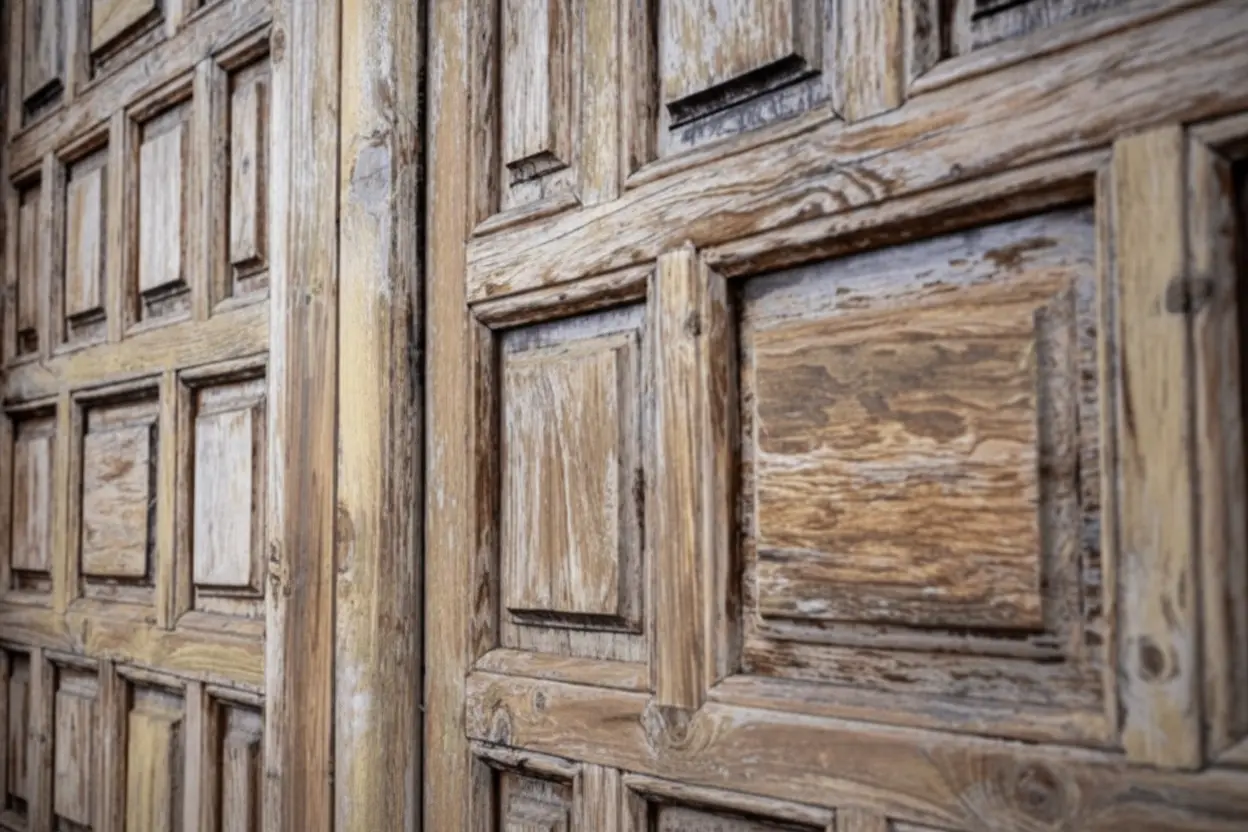
Walk into almost any furniture showroom in the Bay Area and you will be surrounded by wood furniture. Some of it is solid hardwood throughout — teak, mahogany, walnut — built from the same material at every point, visible and hidden, surface and core. Most of it is not. Most of it is engineered board — MDF, particle board, or plywood substrate — with a thin layer of real or simulated wood applied to the visible faces. The showroom will rarely tell you which is which without being asked. The price tag will not tell you either. And the difference, which is invisible to casual inspection at point of sale, becomes one of the most consequential decisions you will make about your home over the following decade.
This guide is for Bay Area homeowners who want to know what they are actually buying before they buy it. It covers what solid wood and veneer each are, how they perform over time, how to tell them apart in a showroom, which hardwoods matter and why, and what all of this means specifically for the rooms — living rooms, dining rooms, home offices — that South Bay households actually use every day.
The terminology in furniture retail is deliberately imprecise, and this imprecision costs buyers money. Understanding what each construction type is — exactly — removes the ambiguity before you enter a showroom.
Solid wood furniture is made from timber cut directly from a tree and milled into boards, panels, or structural members. The grain runs through the full thickness of the piece. In genuinely solid construction, every component — top, sides, drawer boxes, internal structure, and back panels — is made from timber, not a composite core. When a dining table top is solid teak, it is teak at full depth, not at 0.6mm depth. It can be sanded, refinished, repaired, and improved. It develops visual depth and warmth with honest use in a way that no other construction replicates.
Veneer is a thin slice of real wood — typically between 0.5mm and 3mm thick — applied to the surface of an engineered substrate: MDF (medium-density fibreboard), particle board, or plywood. The visible surface can look identical to solid wood. The core is not timber. In better furniture, the substrate is often plywood. In mass-market furniture, it is typically MDF or particle board.
There is a third category that deserves explicit naming: laminate, in which the surface layer is not wood at all but a printed film bonded to a substrate. Laminate is sometimes misrepresented as veneer. It cannot be refinished and has no place in a furniture purchase at a serious price point. Any retailer unable to confirm clearly whether a surface is solid, veneered, or laminate should be asked until they answer directly.

The comparison below covers the meaningful dimensions of the solid wood versus veneer question — durability, repairability, visual development, tactile and acoustic character, and what each material produces in a Bay Area room over time.
Solid wood vs veneer — every variable
Applied to dining tables, case furniture, seating frames, and home office pieces.
Not all solid wood is equal. The hardwoods below represent the benchmark for furniture built to last — the materials the best craftspeople have worked with for centuries, and the ones that define the Reeva Sethi Home collection in Saratoga.
Teak
Tectona grandis · Janka hardnessThe benchmark hardwood for dining tables and case furniture. Naturally oil-rich, resistant to moisture and warping, and capable of developing depth with age and periodic oiling. Performs under real life, not just showroom lighting.
Shop Teak & Heritage Furniture →Mahogany
Swietenia spp. · Janka hardnessClose-grained, stable, and richly coloured. Excellent for fine joinery and detail. The tone deepens over decades, especially with wax and oil finishes that develop rather than simply seal.
Shop the Collection →Walnut
Juglans nigra · Janka hardnessDark, warm, and decisive. Strong visual character and excellent workability for refined profiles. Particularly effective in cooler palettes common in many Bay Area interiors.
Shop the Collection →These five tests require no specialist knowledge. They can be performed in any showroom in two minutes. Any retailer of genuinely solid furniture will welcome them — because a piece built honestly has nothing to hide.
Five ways to tell solid wood from veneer
Apply these in any showroom — in Saratoga or anywhere else — before committing to a significant purchase.
On solid wood, grain continues through thickness. On veneer, face grain often stops at the edge and transitions to banding, a different strip, or reveals a different core on hidden surfaces.
Solid timber is consistent throughout. Veneer construction commonly reveals a flat, uniform underside, or visible composite/ply layers at edges.
Solid teak and mahogany feel substantial. If a visually “heavy” piece feels oddly light, you are not dealing with solid hardwood throughout.
Solid hardwood produces a deeper, denser tone. MDF and particle board produce a flatter, hollower sound.
Ask: “Is this solid hardwood throughout, including internal structure and underside?” A serious retailer answers clearly: species, any secondary woods, and construction method. Anything else is marketing.
You can apply all five tests in the showroom. We will tell you the construction method and timber species directly, for every piece, without theatrics.
The strongest argument for solid wood furniture is not the showroom test — it is the timeline. Bay Area homes cycle through seasons, humidity variations, decades of daily use, and the accumulated evidence of family life. The following timeline shows what each construction type produces across that span.
What veneer and solid wood each produce over time
In the first years, a high-quality veneered piece and a solid hardwood piece can look identical. This is why the decision is easy to postpone — and why many buyers only learn the difference after ownership begins.
Solid wood: finish begins to develop. The surface is still “new.”
Veneer often shows edge wear at contact points. Small chips can expose core material. In humid seasons, early lifting can appear at stress points and edges depending on substrate and build quality.
Solid wood: early patina. Colour deepens, grain reads richer. Marks of use begin to look like life, not failure.
Veneer furniture often needs workaround fixes in this period: edge repairs, cosmetic patching, or replacement. Refinishing is constrained by thickness, so restoration options remain limited.
Solid hardwood: the piece becomes itself. A dining table absorbs years of use and can be restored if desired without losing the material that matters.
At this age, many veneered pieces are difficult to bring back cleanly. When the surface fails, replacement becomes the default. The cost of that replacement cycle is the hidden bill in “cheaper” construction.
Solid hardwood: mature furniture. It can be refinished, kept, handed down. It stays in the home because it still deserves to.
Solid hardwood furniture — teak, mahogany, walnut — available in person on Saratoga–Los Gatos Road.
At 20430 Saratoga–Los Gatos Road in Saratoga, California, you can evaluate solid hardwood pieces in person alongside the room layers that make them live well: rugs, tapestries, and fabrics. Serving Saratoga, Los Gatos, Los Altos, Palo Alto, Menlo Park, Cupertino, Campbell, and greater San Jose.
Saratoga, CA 95070
10:00 am – 6:00 pm
Palo Alto · Menlo Park · Cupertino
Is solid wood furniture better than veneer?
For longevity, repairability, and the quality of a room over time, solid wood is better than veneer in almost every meaningful respect. Solid wood can be sanded, refinished, and repaired. Veneer cannot be sanded without breaking through the surface layer, and lifting caused by moisture is often irreversible. The Reeva Sethi Home collection emphasizes material integrity and long-term ownership.
How can you tell if furniture is solid wood or veneer?
Examine edges and corners, check the underside, assess weight, do a knock test, and ask the direct question: “Is this solid hardwood throughout?” A serious retailer answers clearly: species, any secondary woods, and construction method.
What are the problems with veneer furniture?
Common issues over time include edge wear exposing the core, surface lifting, and limited restoration options because the veneer layer is thin. Once it fails, replacement is often the only clean solution.
What is the best solid wood for furniture?
Teak is a benchmark for density and stability. Mahogany offers refined grain and deepening colour. Walnut brings warmth and character, especially in cooler palettes. The right wood depends on use and desired ageing.
Can veneer furniture last as long as solid wood?
High-quality veneer over plywood can last, but restoration is limited when wear shows. Solid wood can be maintained and restored repeatedly, which changes the long-term value equation.
Where can I buy solid wood furniture in the Bay Area?
Reeva Sethi Home at 20430 Saratoga–Los Gatos Road, Saratoga CA serves Saratoga, Los Gatos, Los Altos, Palo Alto, Menlo Park, Cupertino, Campbell, and San Jose. Call +1 408-797-5283 or book an appointment to evaluate pieces in person.
Solid hardwood furniture — teak, mahogany, walnut — built for long-term ownership. Available in person in Saratoga.
Shop the Collection Book a Showroom Visit Bespoke Consultation20430 Saratoga–Los Gatos Road · Saratoga, CA 95070 · 408-797-5283
Reeva Sethi Home is a Saratoga-based showroom and design studio, launched in July 2025, serving the Bay Area — with heritage furniture, architectural rugs, handwoven tapestries, luxury fabrics, and bespoke interior services. RS Studio is its editorial imprint.