

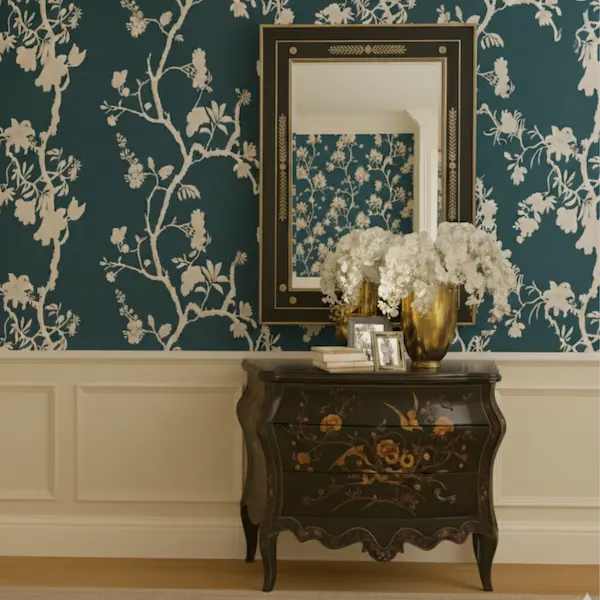
Bay Area Interior Design: Mixing Modern & Antique
A disciplined method for layering periods without noise: proportion, material honesty, and lasting authority.
The rooms that endure — that appear in the background of family photographs for fifty years without apology — are never the product of a single era, a single purchase, or a single point of view. They are accumulated. Layered. Arrived at slowly, with the confidence that comes from knowing what you are looking for before you find it. Bay Area interior design mixing modern and antique styles is not a trend. It is the oldest and most honest method of furnishing a home — and the Bay Area, with its particular collision of innovation and heritage, may be its most natural habitat.
Why Bay Area Interior Design Mixing Styles Produces the Finest Rooms
There is a particular kind of room that announces its furniture budget the moment you walk in. Every piece arrived at the same time, from the same source, chosen for the same reason. It is coordinated the way a uniform is coordinated — technically correct, personally absent. The opposite of this is not chaos. It is the collected interior: a room where each piece has earned its position through a different story, a different moment of recognition, a different understanding of what permanence looks like.
The Bay Area has always understood this instinctively. This is a region where Victorian architecture houses founders working at the frontier of artificial intelligence, where a mid-century study might hold a partner’s desk from 1890 and a monitor from last year, and where the most sophisticated homeowners have long understood that provenance adds a dimension to a room that no showroom can replicate. The cultural duality of the Bay Area — tradition and disruption, inheritance and invention — makes it uniquely suited to the mixed interior.
What distinguishes the finest examples of Bay Area interior design mixing styles is not the audacity of the contrast but the authority of the intention. A room does not succeed because it contains both an 18th-century settee and a contemporary sofa. It succeeds because whoever assembled it understood why those two pieces belong together — the scale relationship, the material conversation, the way one makes the other more legible. That understanding is what this guide is about.
Four Principles for Mixing Modern and Antique Furniture with Authority
Mixing periods well is not intuition — or rather, it is intuition built on structural understanding. Every room that looks effortlessly collected was assembled according to principles its maker may not have named but never violated. These are those principles.
Establish a Dominant Era — Then Break It Deliberately
Every successful mixed interior has a gravitational centre. One era, one sensibility that accounts for roughly sixty to seventy percent of the room’s character. This is not timidity; it is architecture. A room without a dominant voice is a room without a point of view, and without a point of view, no amount of beautiful individual pieces will produce a beautiful room.
The dominant era sets the terms. Everything else responds to it — confirming it in some moments, contradicting it in others, but always in relationship to it. This is what distinguishes deliberate contrast from decorative noise.
Contemporary Foundation
- Modern sofa and primary seating as the quiet backdrop
- Clean-lined primary tables to hold the calm
- Heritage accent chairs for character: wingback, cane armchair
- Antique casegoods for permanence: mahogany chest, library bookcase
- Contemporary lighting — let the heritage pieces carry the warmth
Heritage Foundation
- Traditional seating as the room’s anchor and primary statement
- Antique or reproduction casegoods for structural permanence
- Modern art in unadorned frames — sharpens contrast without apology
- A single contemporary lighting fixture to maintain present-tense clarity
- Clean-lined side tables to prevent the room from reading as period-room
Find the Common Thread — and Pull It Through Every Decision
The question is never whether two pieces from different eras can occupy the same room. They always can. The question is whether they have anything to say to each other. Finding that conversation — and extending it through every decision in the room — is the technical core of mixing styles with authority.
The common thread is rarely obvious. It operates beneath the surface: wood undertones that share a warmth even when the species differ, a quality of finish that reads as craftsmanship across periods, a scale relationship that creates visual rhyme without visual repetition. A hand-carved mahogany coffee table pairs with a modern linen sofa because both speak the same language of material honesty. A handwoven tapestry complements a minimalist room because both are the product of intention rather than production.
The four threads that carry across periods most reliably: material affinity (warm woods harmonise regardless of period), palette coherence (a consistent colour story bridges centuries), proportional relationship (pieces that share a scale family read as a family), and quality register (craftsmanship speaks across styles in a way that mass production never can).
Compose Contrast — Never Stumble Into It
The finest mixed rooms are composed, in the musical sense: each contrast is placed, not discovered. A sleek modern console beneath an ornate gilded Rococo mirror succeeds because the juxtaposition is absolute — each piece is fully what it is, and the gap between them creates the tension that gives the room its energy. A half-hearted contrast, where neither piece commits to its era, produces neither tension nor resolution. It produces muddle.
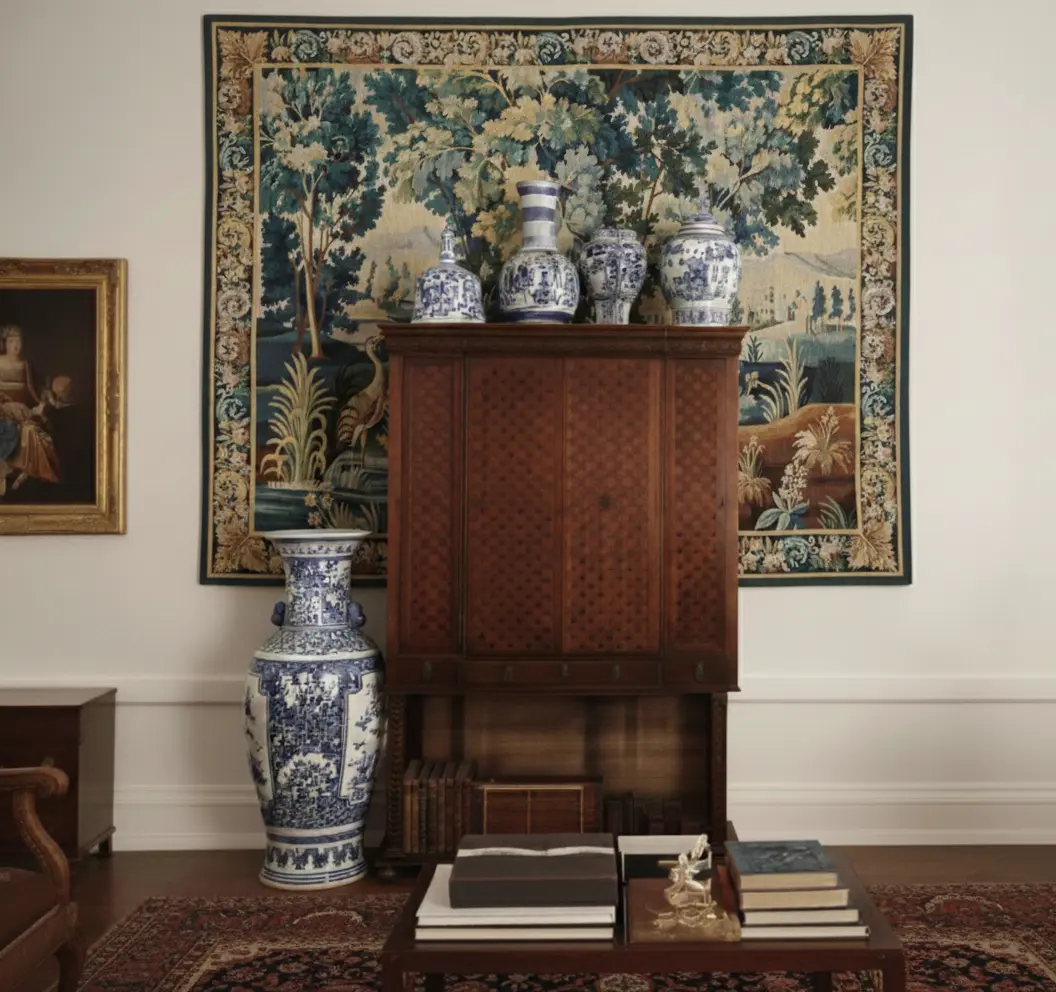
Contrast that works: a woven lounge chair beside a contemporary sectional; a minimalist room anchored by a sculptural heritage coffee table; white walls holding a rich French verdure tapestry as a focal point. In each case, both sides of the contrast are uncompromised. That integrity is what makes the composition land.
Distribute Visual Weight — Do Not Cluster It
Heritage furniture carries visual weight that contemporary pieces, by design, often do not. Left unmanaged, this asymmetry will pull a room out of balance — one corner heavy with presence, the rest feeling unresolved. The correction is not to remove the heritage pieces but to distribute their weight deliberately across the space.
If one wall holds a substantial mahogany bookcase, the opposite wall requires a counterweight: a bold contemporary artwork, a strong sofa, or a sculptural floor lamp with enough presence to hold the conversation. This equilibrium — achieved without matching — is one of the defining characteristics of rooms that read as both composed and effortless.
How to Apply Mixed-Style Interior Design in Every Room
Principles translate differently from room to room. Here is how the finest Bay Area interiors apply the method of mixing modern and antique furniture across specific spaces — with the specific pieces that execute each approach with the most authority.
The Living Room
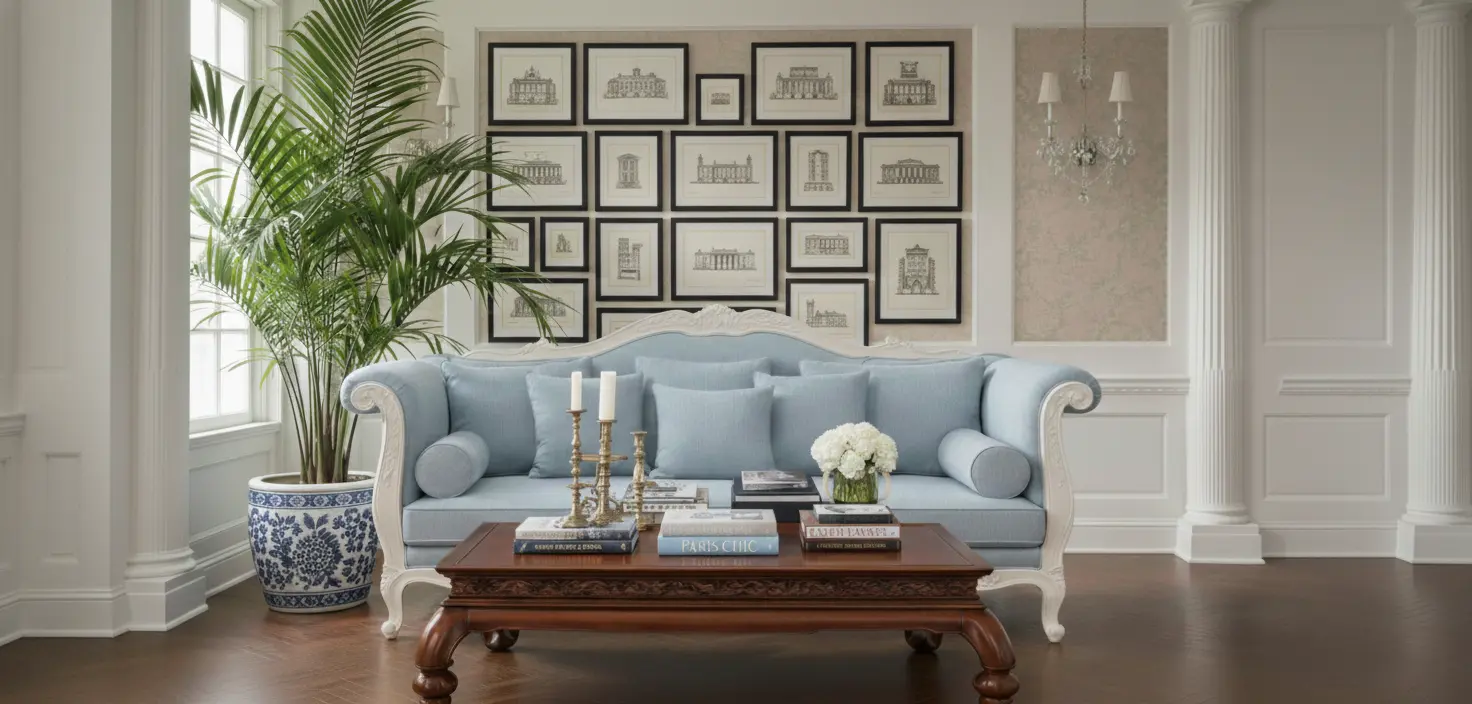
The living room is where the mixed interior makes its fullest argument. The most successful approach places a contemporary sofa — generous, in quiet neutral upholstery — as the room’s grammatical subject. Everything else is subordinate to it: a hand-carved heritage coffee table as the direct object, a pair of wingback armchairs as accent notes that carry the room’s warmth.
For the heritage-dominant approach: the seating anchors in tradition, the art on the walls is contemporary, and a single casegood in dark mahogany provides the room’s architectural permanence.
The Dining Room
Dining rooms offer the cleanest opportunity for decisive contrast. The table and the chairs need not agree on period — they need only agree on quality. A heritage table in mahogany beneath a contemporary chandelier: the vertical contrast gives the room its tension. Chippendale host chairs at the ends of a contemporary table: the horizontal contrast gives it narrative.
A butler’s tray table against the wall introduces heritage ritual without demanding heritage throughout. It is enough.
The Library & Home Office
No room makes the case for mixing styles more powerfully than the home office. The intellectual life of the Bay Area’s most accomplished professionals demands both the efficiency of modern tools and the gravitas of a space that takes thought seriously. A heritage library table provides that gravitas; the contemporary monitor positioned on it does not diminish it — it confirms it.
A floor-to-ceiling mahogany bookcase behind a modern task chair: this is not irony. It is the visual argument that the best work is always in conversation with what came before it.
The Primary Bedroom
Bedrooms reward the approach of keeping the primary pieces — bed, upholstered headboard, bedding — quiet and contemporary, while the storage and occasional furniture carry the heritage weight. A mahogany dresser or chest against a neutral wall: the patina reads as warmth, not formality. A reading chair in wingback form near the window: comfort elevated to occasion.
The bedroom should feel accumulated rather than furnished. More than any other room, it benefits from time.
The Role of Textiles in Mixing Interior Styles
If furniture is the architecture of a room, textiles are its atmosphere. They are the most powerful tool available to anyone mixing periods — because a heritage textile draped over a modern chair does not ask permission. It simply belongs, in the way that all natural materials belong: immediately, without explanation.
The reason textiles bridge periods so naturally is that quality craftsmanship — hand-weaving, hand-finishing, natural fiber — reads as quality craftsmanship regardless of the century in which it was made. A handwoven textile does not have a date. It has a character. And character speaks across styles in a way that style alone cannot.
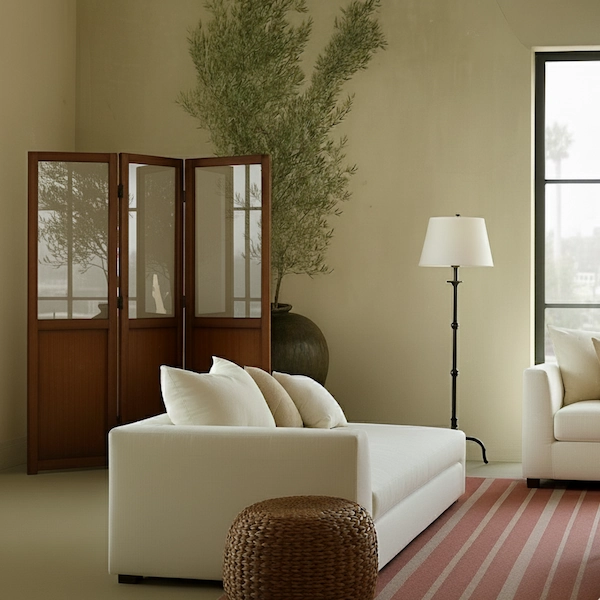
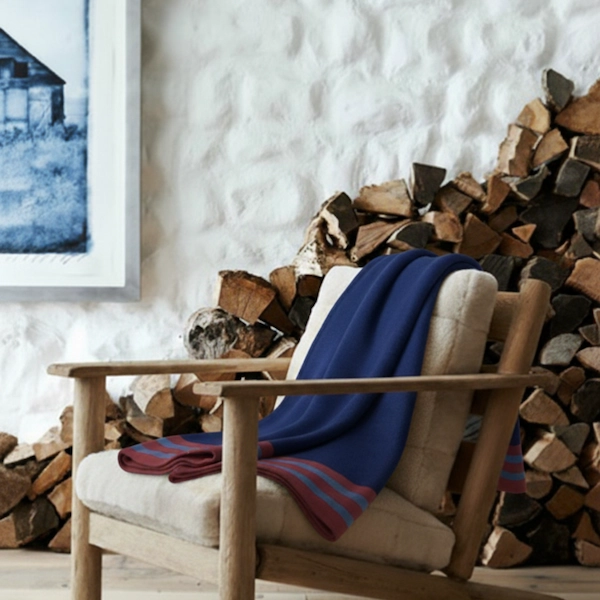
The textile hierarchy for the mixed interior, in order of structural importance: first, the rug — the room’s foundation, its emotional ground plane, the piece that must be chosen before any furniture decision is finalised. A natural fiber or antique rug works with any era because it predates the question. Second, wall textiles — a handwoven tapestry on a clean wall does what no art print can: it introduces pattern, warmth, and evidence of human time simultaneously. Third, throws and textile pillows — the details that soften every contrast and make a composed room feel inhabited rather than arranged.
Four Errors That Undermine the Mixed Interior
The mixed interior is forgiving in some ways — it accommodates discovery, inheritance, and revision in ways that the matched room cannot. But it is unforgiving about certain structural errors, because those errors are not matters of taste. They are matters of logic.
Too Many Eras
Two periods in conversation produce tension. Three produce complexity. Four or more produce noise. Select two eras — three at the outermost limit — and commit to the conversation between them.
Forcing Wood Tones to Match
Woods do not need to match. They need to harmonise. Warm undertones connect; identical finishes merely coordinate.
Ignoring Scale Relationships
Heritage furniture was often made for rooms with higher ceilings and more generous proportions. A substantial wingback chair requires a sofa of proportional visual weight. Settle the proportions before the upholstery conversation begins.
Inconsistent Quality Register
A fine antique reproduction alongside obviously inexpensive modern furniture creates a quality gap that makes both pieces look worse. Quality is the common language. Keep it consistent.
How to Begin Mixing Antiques with Modern Furniture
The mixed interior is assembled, not installed. The right way to begin is with a single, considered heritage piece introduced into an otherwise contemporary room — not as an experiment, but as a declaration. A cane armchair brought into a modern living room does not merely add character. It changes the room’s relationship with time.
From there, additions follow naturally — not by formula but by the logic of what each new piece needs. A butler’s tray table. A mirror. A quality textile over the arm of the contemporary sofa. The room does not arrive at a destination. It deepens.
The most important thing to understand about mixing modern and antique furniture is that it does not require a complete reimagining of what you already have. It requires one honest piece, chosen with intention, that reframes everything around it.
Unlike a matched furniture set, the mixed interior cannot be finished in an afternoon. It takes years. This is not a limitation — it is the point.
Reeva Sethi Home — located at 20430 Saratoga Los Gatos Road, Saratoga, California — carries the handcrafted furniture, handwoven tapestries, and quality textiles that serve as the heritage anchors of the finest mixed interiors in the Bay Area. Every piece was selected against one standard: whether a disciplined designer would still specify it in thirty years.